The launch of The New Boycott Crisis

Westminster, April 2026.

Six speakers gathered in the Churchill Room at the Palace of Westminster on 27 April 2026 to launch FITA's second report. A Member of Parliament. FITA's co-director. The CEO of a comedy chain. A Jewish musician whose band had been cancelled in Bristol and Brighton. A singer-songwriter who'd watched venues drop her bookings after speaking publicly. A literary agent in closing remarks. Each named the crisis from where they stand.

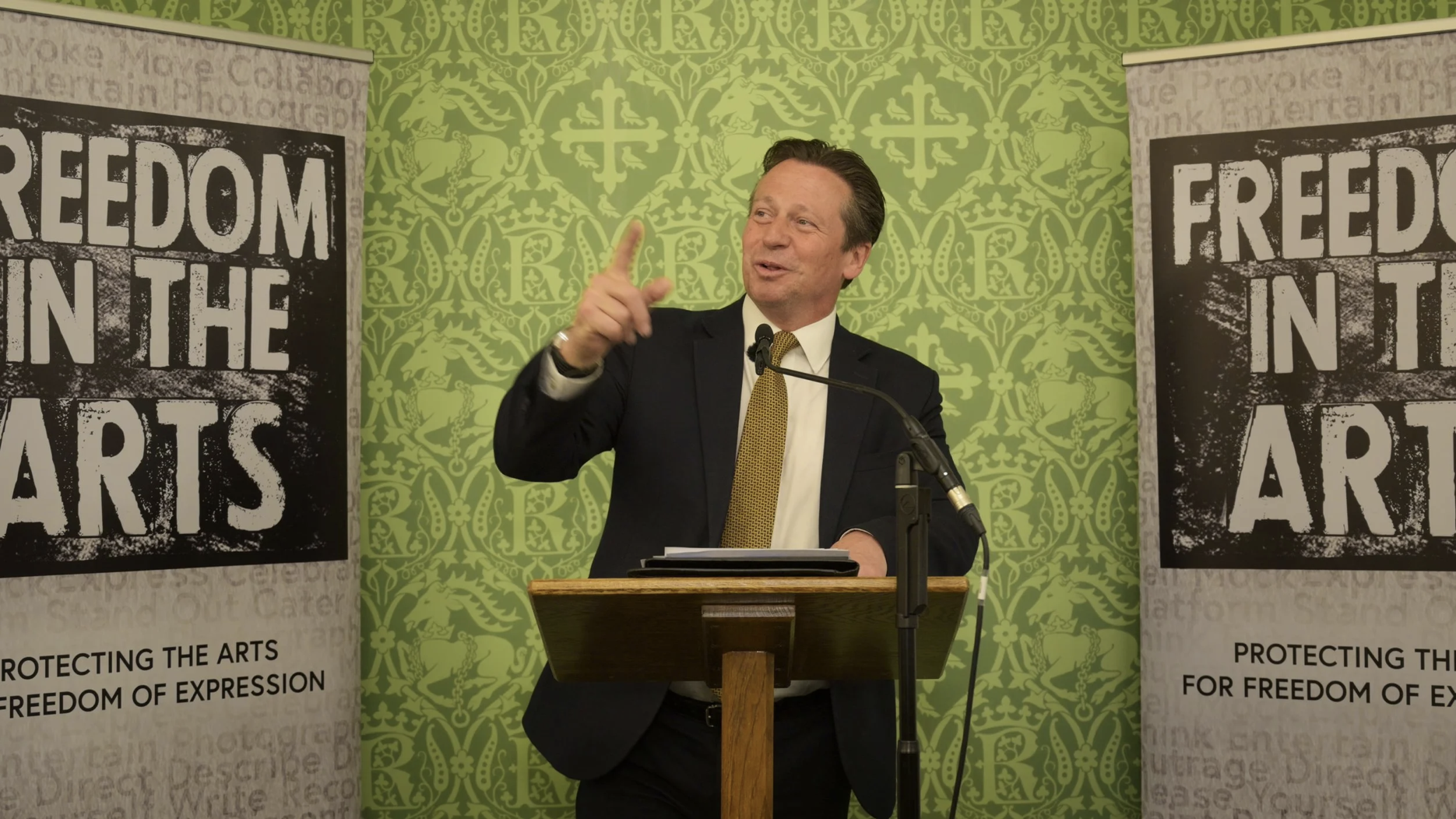
· Shadow Secretary of State for Culture, Media & Sport

"When freedom of expression in the arts is narrowed by fear, intimidation or organised pressure, that is not only a cultural concern. It is a democratic one."

Opening the launch as Shadow Culture Secretary, Huddleston framed the boycott crisis as a democratic concern, not only a cultural one. He named anticipatory compliance as the mechanism doing most of the damage — venues and festivals making decisions in fear of campaigns that have not yet happened, each act of compliance making the next one easier. He gave particular weight to the report's finding that Jewish and Israeli artists are disproportionately affected by organised pressure, and called the climate inconsistent with the British values of freedom, tolerance, and respect. He closed by signalling that Conservative policy review will draw on the report.
Read Nigel's full speech

Good evening, everyone, and welcome. It is a real pleasure to join you here in Parliament for the launch of Freedom in the Arts' new report, The New Boycott Crisis, and the accompanying Art Beyond Boycott Toolkit.

Thank you all for being here, and thank you in particular to Rosie Kay, Denise Fahmy and Professor Jo Phoenix, authors of The New Boycott Crisis.

This report is an important and timely contribution to a debate that has too often been conducted in fragments — through noisy rows and media headlines. The report brings evidence and structure to something many people in the sector have felt for some time: that pressure, fear and organised intimidation are beginning to shape the conditions in which art is made.

The New Boycott Crisis exposes how pressure and boycott movements are devastating the arts; we are seeing cancellation, professional exclusion, harassment and compelled political positioning. And sadly this is not simply a matter of a few isolated controversies, or the occasional disagreement that inevitably comes with a lively artistic culture.

The report highlights what the authors call "boycott logic" — an interconnected pattern of pressure, reshaping what artists, venues and organisations feel able to create, present and discuss. And that should concern us all.

The arts are not some optional extra in national life. The arts are where a society imagines, questions, remembers and argues with itself. It is where freedom of thought becomes a living and public experience. Freedom of expression is not peripheral to democracy. It is part of its texture and one of its tests.

In any healthy democracy, the arts should be places of experimentation, disagreement, curiosity and risk. They should not become places where people are forced into silence by fear, reputational intimidation or organised campaigns. And yet that is precisely the concern The New Boycott Crisis raises.

The report describes a climate in which many artists, particularly freelancers dependent on reputation and networks of goodwill, are finding opportunities disappearing not because of the quality of their work, but because of who they are, what they are assumed to believe, or the controversy others fear may follow. Venues and festivals increasingly make decisions not in response to actual protest, but in anticipation of what might happen, often under internal staff pressure rather than audience demand.

This is the notion of anticipatory compliance. Where the damage is often done before any public campaign even gets going. Where the possibility of backlash becomes enough to shape decisions. And each act of compliance makes the next one easier.

That matters not only for the arts, but for public life more broadly. When freedom of expression in the arts is narrowed by fear, intimidation or organised pressure, that is not only a cultural concern. It is a democratic one.

The arts should challenge and question and push boundaries. But there is a world of difference between pushing boundaries — having a respectful and informed, robust debate — and intimidation or cancellation; or worse: promulgating hatred. Pushing extreme views and cancelling out others is not normal, it is extremist behaviour, and is inconsistent with core British values. Core Conservative values, if I may, of freedom, democracy, tolerance, genuine inclusivity, responsibility, and respect — for each other and for law and order.

And that brings me to one of the most serious findings of The New Boycott Crisis report. The report is clear that antisemitism is not incidental — it is one of the most troubling features of this boycott logic.

The evidence gathered suggests that Jewish and Israeli artists are disproportionately affected by organised pressure, and that Jewish artists are too often subjected to exceptional scrutiny, exclusion or suspicion. Jewish artists and Jewish cultural life become treated as uniquely contentious, uniquely risky, or somehow inherently political. That should trouble all of us.

Where Jewish cultural life is treated as inherently problematic, or where Jewish identity itself becomes a trigger for pressure and distrust, that should concern anyone who values fairness, democracy and the integrity of our public culture.

Of course, this is not about endorsing every work or every point of view. None of us agree with every point, every view, every piece of art or expression performed by everyone in this room this evening. But it is about whether our arts sector remains a place where disagreement can exist without coercion and intimidation, and where institutions have the confidence to act lawfully, proportionately and fairly.

That is why the second part of tonight's launch matters just as much as the first. Because alongside the report, Freedom in the Arts is also launching the Art Beyond Boycott Toolkit. This is a practical response to boycott pressure. It provides clear guidance, step-by-step tools, templates and checklists. It recognises both lawful protest and artistic independence. It is not just diagnosing a problem. It is helping the sector respond to it.

And government and politicians have a role here, too. Democratic institutions should not be indifferent when fear begins to shape public culture. Parliament is exactly the right place to have this debate. The concerns raised by this report deserve serious engagement from ministers, officials, politicians and all those responsible for the health of our cultural institutions — especially those that are publicly funded or lottery funded.

The debate is timely. We, the Conservatives, are conducting our own policy review, and this report will input into that. We are considering the role, purpose, remit and distribution criteria for lottery funding bodies. And we are of course in a live debate about the funding and scope of the BBC and how it abides by its impartiality obligations.

Tonight is important for many reasons, because we are discussing real life experiences, evidence and principles. Most of all it is recognising that artistic freedom is not a luxury. It is one of the conditions of a confident and truly free society.

I want again to thank Freedom in the Arts for the work they have done in bringing this report and toolkit forward, and for the support they have already provided to artists and organisations under pressure. This is work of real public value. And it now gives me great pleasure to invite Rosie Kay, co-director of Freedom in the Arts and co-author of the report, to speak about the work that has brought us here this evening.
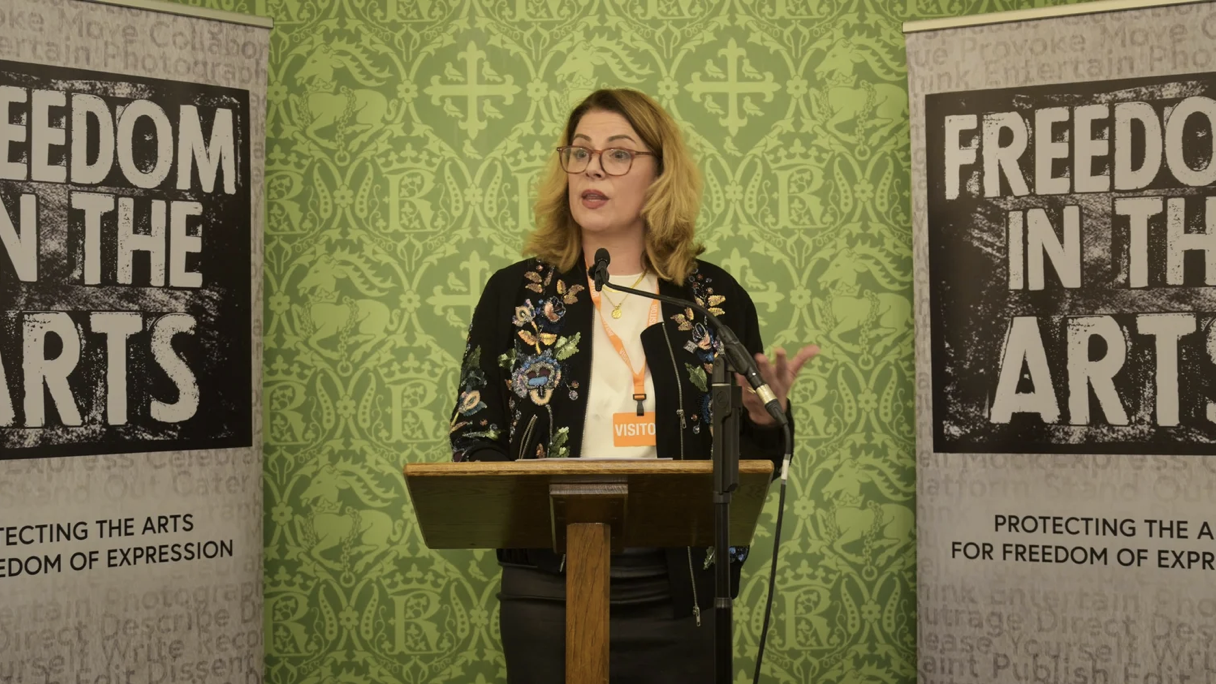
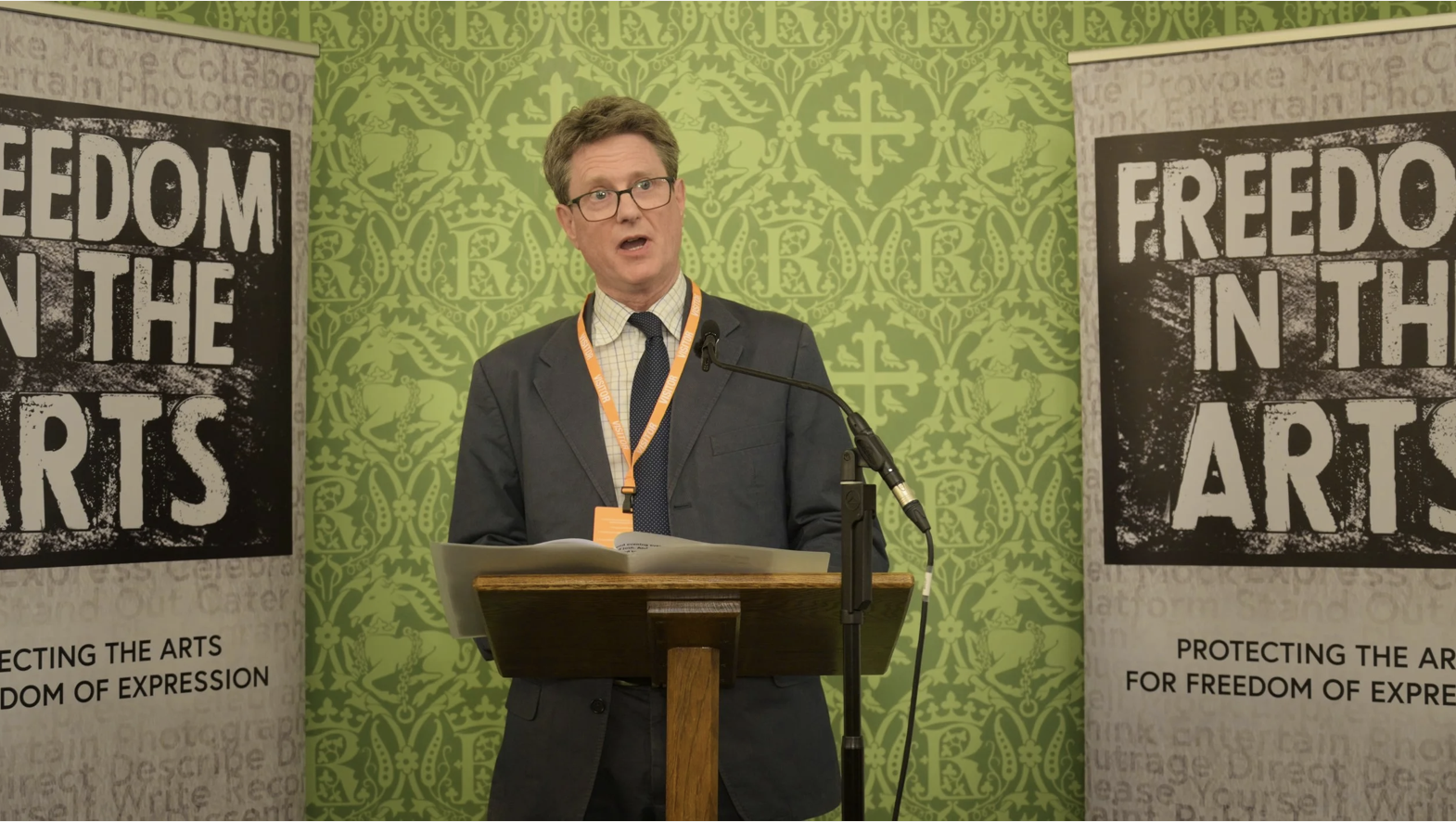
· Co-director, Freedom in the Arts · Co-author, The New Boycott Crisis

"The arts can survive criticism. They cannot do their best work under intimidation."

Kay opened in personal register before pivoting analytical: FITA exists because too many people were being dropped, ghosted, quietly sidelined — ordinary professional life withdrawn under cover of risk-aversion. She named the fear that gets normalised inside institutions and the self-censorship that follows, and gave particular weight to antisemitism in the sector — Jewish artists and Jewish cultural life now treated as uniquely contentious, with support quietly withdrawn rather than publicly contested. She set out FITA's four purposes — supporting those under pressure, documenting what is happening, connecting isolated practitioners, and providing practical assistance — and introduced the Art Beyond Boycott Toolkit as the calm, lawful, proportionate counterpart to the report.

Read Rosie's full speech

Thank you, Nigel, for hosting us this evening, and thank you for those generous words.

And thank you all for being here — Members of Parliament, peers, artists, arts leaders, friends, supporters, journalists, donors, and everyone who cares about the future of cultural life in this country.

And before I go any further, I do want to say a quick thank you for the coverage this work has already received in the press and on broadcast today and last night. We are very grateful to those journalists who have taken these issues seriously and helped bring them into public view. That matters, because too much of what this report describes has been allowed to happen quietly, or to be brushed off as just another arts row.

We are here tonight to launch The New Boycott Crisis and the Art Beyond Boycott Toolkit.

I did not set out to become a campaigner on this issue, and I am not here because I enjoy public conflict. I am here because I care deeply about the arts, because I have spent my life in them, and because I could see too many artists and organisations being left alone to deal with fear, pressure and exclusion.

The arts can survive criticism. They cannot do their best work under intimidation.

Freedom in the Arts was founded because too many people were being dropped, ghosted, quietly sidelined, or made to feel that they had become somehow too difficult, too risky, too politically awkward to support.

Artists were being left to make sense of that alone. Venues were trying to navigate it alone. Organisations were hoping that if they kept their heads down, the storm would pass them by.

One of the most important things FITA has done is simply to recognise the issue — to say clearly that this is happening, and that the people experiencing it are not imagining it and are not alone.

Because once fear becomes normal, people begin to adapt to it. They lower their expectations. They say less. They risk less. They quietly edit themselves. Institutions start making decisions not because anything has happened, but because they are frightened of what might happen. A possible backlash becomes enough. A rumour becomes enough. A handful of emails becomes enough.

What The New Boycott Crisis shows is that what are often treated as isolated incidents are in fact part of a broader pattern: political pressure, cancellation, professional exclusion, harassment, compelled positioning, and a growing atmosphere of anxiety in which people feel they must constantly calculate risk before they speak, programme, publish, perform or even associate.

Artists experience that in lost work, silence, damaged relationships and self-censorship.

Venues experience it in fear, confusion, and decision-making shaped by panic rather than principle.

Agents and managers experience it by becoming the people who have to advise artists to stay quiet, pull back, or disappear for a while.

And audiences experience it too, whether they know it or not, because they end up with a thinner, narrower and more frightened culture.

Part of what we have also had to do is name clearly the extent to which antisemitism has become embedded, denied or minimised within parts of the arts sector.

Many people have been reluctant to face this honestly. But the report is very clear: Jewish artists and Jewish cultural life have become especially vulnerable to exclusion, scrutiny and silence.

And what is so disturbing is that this can happen in very quiet ways. Not always through a dramatic public row. More often through the slow withdrawal of support, the coded language of sensitivity, the feeling that Jewish identity itself has somehow become too contentious, too political, too difficult to deal with. Opportunities dry up. Invitations disappear. People become nervous. Institutions equivocate.

Because we are not simply describing the problem; we are trying to build ways through it.

The Art Beyond Boycott Toolkit is there because people need more than sympathy. They need guidance. They need clarity. They need somewhere to turn when the emails start, when the pressure builds, when internal panic sets in, when boards get frightened, when staff are divided, when legal questions arise, and when institutions suddenly find themselves without the language or confidence to hold the line.

The toolkit is intended as a practical response: calm, lawful, proportionate, usable.

Because too many people in the sector have been trying to navigate all this without any map.

And I want to say very clearly that this work has only been possible because people trusted us. Artists trusted us. Arts leaders trusted us. People told us things they had not felt able to say elsewhere. They described experiences that were often painful, humiliating and professionally risky to talk about. That trust is an enormous responsibility, and I hope tonight honours it.

I also want to say how fortunate we are tonight in the people speaking with us. Josh Breslaw, Mark Tughan and Róisín Murphy are not abstract voices or professional campaigners. They are the real deal — artists and arts leaders who know these pressures from the inside, and who care deeply about protecting the conditions in which real cultural life can flourish.

Thank you to Professor Jo Phoenix, our co-author, for her rigour, courage and clarity. And above all, thank you to my co-director Denise Fahmy, whose intelligence, steadiness and fierce commitment have been central to everything FITA has built.

We are making a real difference. But the scale of the challenge is greater than any one report, any one toolkit, or any one event.

If we want a freer, braver and more open arts culture, this work now needs wider backing — from allies, from institutions, from policymakers, from philanthropists, and from everyone who understands that artistic freedom is not a side issue. It is one of the conditions of a healthy and confident society.

The report gives shape to what is happening across the sector, but it is equally important to hear what this looks like in lived experience. So I am now delighted to introduce Josh Breslaw of Oi Va Voi, whose experience brings home just how real and consequential these pressures can be.

· Founder & CEO, Glee Clubs

"We were declining shows pre-emptively, censoring ourselves and some acts without it even being known. No paper trails, no proof. And that is insidious."

Tughan, founder of the Glee Club comedy venues, gave the institutional voice already acting. Against a backdrop of cancellations involving Hans Teeuwen, Jerry Sadowitz, and Andrew Lawrence, he described the quieter and more corrosive pattern: shows being declined pre-emptively, never booked, never logged. The art that never happens — what Tughan named as the most insidious kind of self-censorship. Staff fear, HR exposure, reputational anxiety: all of it adding up to a private decision to swerve. He framed FITA's toolkit as the institutional underwriting smaller venues need, and argued that championing freedom of expression is also good business.

Read Mark's full speech

Good evening everyone and thank you Nigel, Rosie and Josh. And can I say it's a huge honour to be invited to this event and to speak to you about the industry I love — live comedy.

My name is Mark Tughan and I am the founder and CEO of a small but slightly significant group of live entertainment venues, called the Glee Club, specialising mainly in comedy. We started in 1994. We may only be 5 venues but we've managed to become the biggest group of mid-sized venues and would probably be described as the market leader.

I say slightly significant because although we are only 5 venues, we are one of the largest bookers of what we call "circuit talent" in the country. And because we're the biggest group of comedy clubs, people have in the past looked to us to see what I hope would be considered best practice.

I want to say first that the world of live comedy is by and large a happy place — after all we are in the business of making people laugh — the sector isn't, from what I can see, tearing itself apart in quite the same way as seems to be happening in others areas — music and perhaps publishing — and our own brushes with cancel culture, whilst real, tend to be slightly more occasional. This is of course notwithstanding the fact that one of the biggest cancel stories ever involves one of our own, namely comedy writer Graham Linehan. I don't think we even need to go there now; the man has been vindicated a thousand times over and it's a source of regret (to me at least) that some of his peers in our industry still can't seem to find the strength to acknowledge any regret for the way he was treated.

Our recent brushes with cancel culture started with me receiving a fatwa from someone who called on us to cancel a show by the Dutch comedian Hans Teeuwen, well known for his absurdist, provocative and confrontational style, but also for allegedly "mocking Islam". In this case we did proceed but I would point out that the West Midlands Police's attitude when we spoke with them was that we should just save ourselves the hassle, and cancel that show. They said they would not commit to any presence whatsoever on the night of the show to keep an eye on the threatened protest, which in the end didn't materialise.

Next up Jerry Sadowitz. His show was famously dropped by the Pleasance at the Edinburgh Festival in 2022. He already had a tour planned for after the festival and we had booked him at 2 of our venues. Cue panic amongst my management team. How on earth were we to deal with this — it was front page news. In the end, we also proceeded; there was little public backlash, but this was when the "problem" morphed into a bit of an HR issue — what about the staff? Should we be subjecting them to this potentially offensive comedian? And it's a fair question. In the end we reminded staff that taking shifts was optional, as was actually watching the show — but it still didn't stop a couple of staff duly watching, taking great offence, and then making complaints. My HR advice was that we had taken the steps required of "a reasonable and considerate employer".

So what's the problem, I hear some say. You're not cancelling shows, you seem to be holding your nerve?

We have recently booked "Britain's most cancelled comedian" Andrew Lawrence. This was something however where I personally had to intervene to ensure it was booked. First it was — he's not funny. Then it was — what about a backlash? Then it became — what about the staff? It has also become: what about the audience of deplorables — what if they abuse the staff? It was abundantly clear that this was being presented to me as just too much hassle, let's just leave it. And that is what angered me, and made me think…

We could be — and I suspect we were — declining shows pre-emptively, and thus we were censoring ourselves and some acts without it even being known. No paper trails, no proof. And that, to me, whilst not the crime of the century, is insidious.

I decided that's just wrong. Already a free speech advocate, to me, quietly swerving a show means we've already surrendered or lost the argument for free expression because it's assumed — pre-ordained even — that such a booking will end up causing so much grief, that it's just better not doing it in the first place. The art that never happens?

And it also struck me that similar conversations may have also been happening within my business without me knowing. I simply can't be across every enquiry, every judgement call. That shows could just quietly be being swerved, quietly declined, based solely on behind-closed-doors whispers and, let's be honest, political prejudices, struck me as quite beyond the pale.

Look, as a private business we are fully entitled to book what we want. But we are also gatekeepers, and as such I feel we have a responsibility to the wider arts world to ensure that we don't just swerve and avoid controversial or alternative shows because of fear of backlash, or HR hassle.

And this is where Freedom in the Arts comes in. Let me be clear, I don't think it was a case of my management team going out of their way to deplatform people but they too were (indeed they are) paralysed with fear. Fear of activists, fear that the public would disapprove in some way, fear for harming our reputation, and also fear we would simply be entering an HR hellhole. I can tell you as a small business, we have little time for endless HR, let alone costly PR for reputation management.

So when I saw that FITA had really thought this through, and done serious legwork in terms of intellectual underpinnings, practical advice and actual tools to assist venues, to me it was a no-brainer. Most people in my sector are tiny businesses operating on shoestrings, both financially and in management bandwidth, and thus to have practical guidance and institutional backing is critical.

I'm going to go a step further and say that in my opinion, seeing venues signing up to a freedom-of-expression agenda is also exactly what the public want and expect. My sense is that people are fed up with the thought police, as well as the taste police, either overtly (or in my case covertly) censoring so-called "problematic" acts out of the cultural sphere. I hope and expect that venues which do positively champion FOE will be rewarded by their customers, and that venues that opt out of FOE will suffer accordingly and deservedly at the box office, as well as reputationally, for their reluctance to embrace true diversity — namely diversity of thought and opinion. To me this is good business as well as the right thing to be doing.

In summary, I think cancel culture has made swathes of the arts (mine included) hugely risk averse, and in comedy, if you don't take risks, it gets dull, it gets safe, it gets a bit boring. For me this is about regaining the confidence to take risks again, bringing the public with us — which I think we can do — and in the end winning a bit of trust back from consumers, some of whom I think believe comedy has just become too safe, and operating within boundaries set by the groupthink of the bubble it has become comfortable in. I want to bring back the sense that in a comedy club — almost anything goes, and funny is just that — funny.

But behind all these decisions and pressures is the artist, and the question of what kind of culture we are asking artists to create within. So it is with great pleasure that I hand over to a legend — Róisín Murphy.

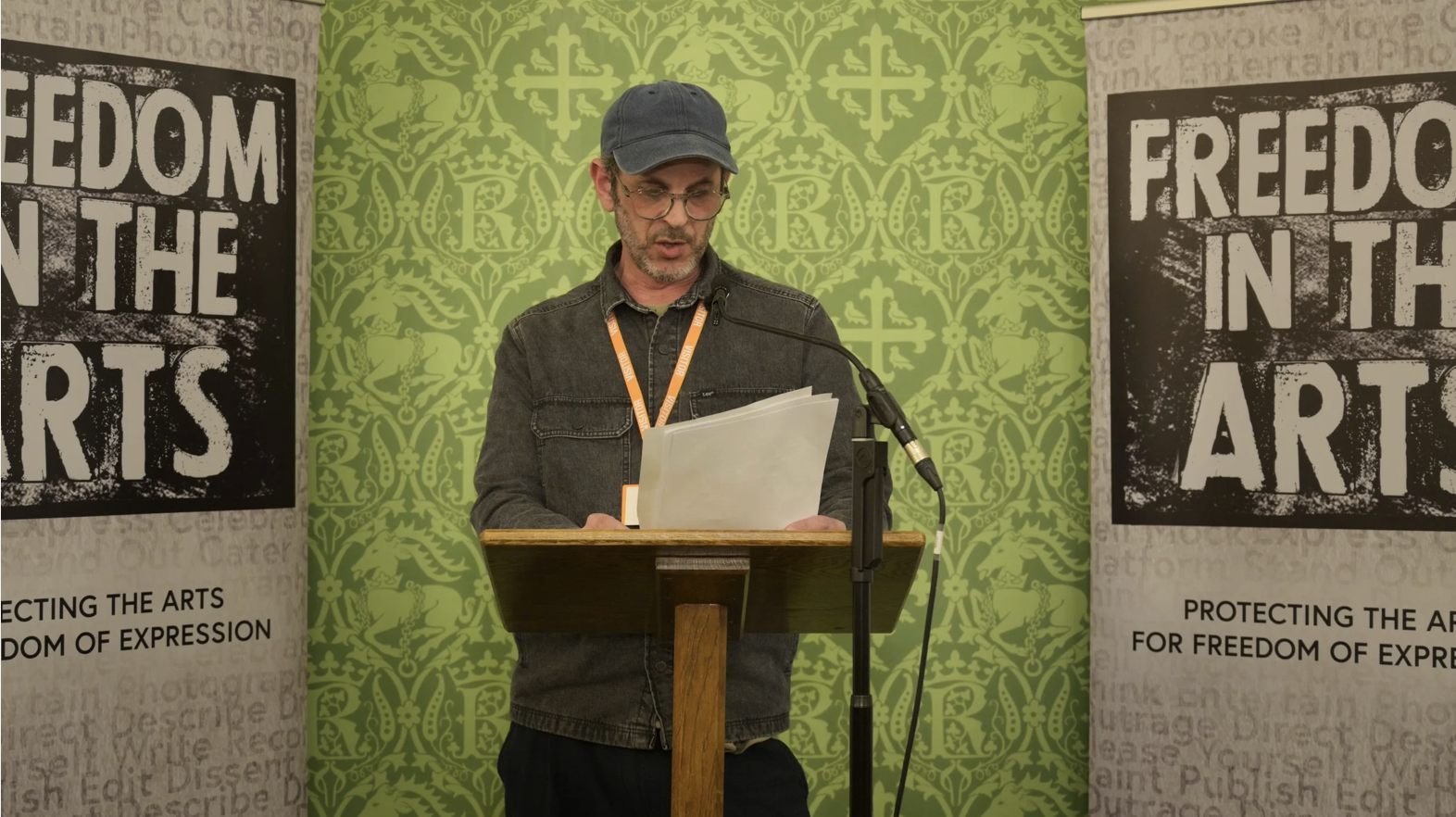
· Drummer, Oi Va Voi

"To be cancelled in your home town for being Jewish is a very depressing experience."

Breslaw, drummer of Oi Va Voi, gave the working-artist account. The band's set draws openly on Jewish cultural sources; for over twenty years that had been their distinction. In May 2025 a Bristol venue cancelled a show after pressure from a pro-Palestinian protest group; Brighton followed within days. He named the cancellations for what they were — racism toward Jewish heritage; xenophobia toward an Israeli band-member born in the wrong place. He distinguished venues that act ideologically from venues bullied and intimidated into compliance, and warned that under boycott logic the cultural world becomes smaller and the society around it less open.

Read Josh's full speech

For over 20 years my band Oi Va Voi has been playing music that draws on its Jewish culture. We use the old sounds, melodies and stories from Jewish history and mix them with a modern, mainstream sound. Our music is socially conscious and human. We have played in many places around the world and we have been really proud to represent a little bit of British Jewish culture.

Although the heart of the band is Jewish, we have never restricted ourselves to only working with Jewish musicians in the band. In the early days at the start of our success we were nominated for a BBC Music Award in the category called 'Boundary Crossing' and throughout our career we have continued to cross boundaries. We perform with musicians that we want to perform with regardless of ethnicity or passport, and we perform for people in countries when we are invited to perform. The perfect example of this British Jewish band called Oi Va Voi crossing boundaries is the fact that one of our biggest fanbases is in Turkey, a Muslim-majority country, where we have never once been questioned about our position on the actions of our or any other government.

Last May Oi Va Voi were on a tour promoting our fifth album. We had just played shows in Holland, Belgium, Hungary and Turkey, all great shows with no problems. We arrived back in the UK for a run of four shows starting in Bristol. I got word that the venue in Bristol had received a complaint from a pro-Palestinian activist group who were asking for our show to be cancelled because we had played in Israel before and we had an Israeli singer performing with us. A call was set up with the venue and I understood we were going to talk about how to make sure the show could go ahead safely. In the call I was told that the venue was supporting the protest group and they were cancelling our show. This was followed by a statement on social media explaining that Oi Va Voi did not meet the ethical standards of their venue. This was obviously devastating, and although our shows in Cambridge and London went ahead, we were also cancelled in Brighton for the same reasons as Bristol. The Brighton cancellation was particularly painful for me as it's where I live and where my children go to school.

I won't go into detail now about the overall fallout for me on that cancellation, but as someone who has performed as a musician with my Jewish band for over 20 years, to be cancelled in your home town for being Jewish is a very depressing experience.

To dare to be Jewish in artistic spaces today means that strangers and activists believe that they have the right to demand you take a position on the issues that are most important to them. If you decline to take a public position because either you think that your creative work speaks for itself, or that taking a position may require more nuance than the person demanding it can understand, then a position will be taken for you. You will then be judged on the position that someone took for you. The most likely outcome is that you will be publicly cancelled, as happened to me and my band, or silently pushed out, as is happening to many others. Our cancellation was both racist and xenophobic.

These are not words usually associated with the British arts sector. My band was pulled up, questioned, and cancelled because of our Jewish heritage — that's just racist. Our singer was cancelled not because of anything she has said or done, but because of where she was born. That is just xenophobic. If you do a thought experiment and imagine that my band was not British with Jewish heritage but was British with Chinese heritage, and our singer was not Israeli but Pakistani, then try to imagine an arts organisation even questioning that band let alone cancelling them — it just would not happen. There is no way any arts organisation would do that. And that is a good thing, obviously. British cultural organisations should be judging art on its artistic merit and artists on the quality of their work, not asking people from specific ethnicities or countries to jump through hoops to satisfy one limited worldview.

There are a few different characteristics when it comes to venues and organisations cancelling music and art. I would say there are a small minority of people running venues and organisations that are driven by an ideology or a cause. These organisations believe that their cause is so righteous that the law doesn't apply to them. They need to be shown where the lines are and told that the law does apply to them regardless of their cause. I saw with my own eyes how the penny slowly dropped for the venues that cancelled my band. When they were informed that they had broken discrimination law, their initial reaction was to loudly defend their chosen cause, but as the realisation set in that there are laws to protect people being discriminated against in this way, and they were breaking those laws, they had no choice but to accept they had been wrong.

And then there are venues and organisations that are not 'cause' driven, but they are being bullied and intimidated by protest groups. These venues and organisations really need help. They need clear guidelines, they need the law to be understood more widely, they need local and national leaders to show some leadership, and they really need the support that is being offered by the Freedom in the Arts Toolkit.

The work that Freedom in the Arts has done in making this toolkit is so important because I think that there is a danger that, through these boycotts, our cultural world will become smaller — and if that happens our society will become poorer and less open.

One of the questions that follows from experiences like mine is how institutions and venues respond when pressure arrives. I've spoken a bit about it from an artist perspective, but for a more expert view from a venue leader I'm pleased to hand over to Mark Tughan.

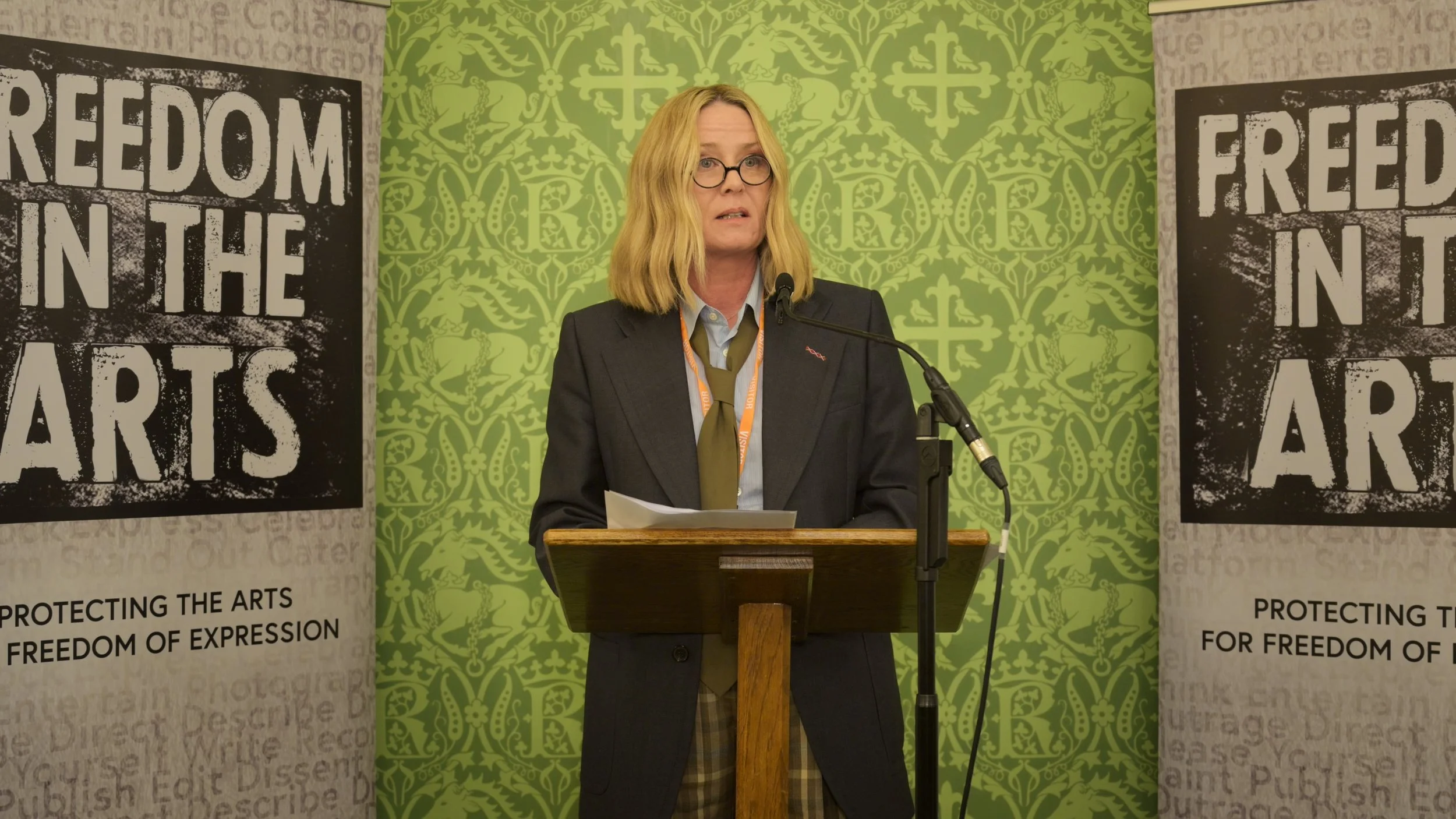
· Singer-songwriter · Keynote

"The creative soul of this country has always thrived on discomfort, on the freedom to be wrong, to offend, to pivot, and to surprise ourselves. Without that freedom, we don't get better art."

Murphy gave the keynote — for thirty years a singer-songwriter and her own creative director, never a campaigner. After speaking publicly on puberty blockers and gender, she watched the machinery kick in: pressure to recant, leaks to the press, cancelled bookings, colleagues stepping back. She fought to keep her work; many do not. She named the deeper damage as crippling self-censorship — the artist's flow state breaking when part of the audience is scanning for a thought crime, and a generation of young creators learning early to play it safe. She ended with a call for the arts to breathe freely again, and for artists not to turn on each other.

Read Róisín's full speech

Ladies and gentlemen, fellow artists and creators — thank you for letting me speak freely here today.

This feels very strange for me. I never wanted to become any kind of campaigner. For most of my creative life I've preferred a bit of mystery, privacy, ambiguity and above all, the freedom to create whatever I want — I've never been a confessional artist. Hastily built identities tend to harden, and as for opinions — well, everybody's got one.

But things have taken a troubling turn, and my experience might be worth sharing here. For thirty years I've lived inside this world — as a singer, songwriter, and my own hands-on creative director. I know its beauty and its brutality. But what I've seen in recent years isn't just the usual ups and downs of creative life. It's a slow, systematic narrowing that turns art from wild exploration into careful calculation.

When artists speak plainly these days, especially on radioactive issues, they don't get debate. They get condemnation and professional exile. I've lived it. After I spoke my mind about puberty blockers and current social trends around gender, I watched the machinery kick in fast: pressure to recant, threats to pull promotion, leaks to the press, venues dropping bookings, colleagues stepping back. The message was clear: conform, or risk your livelihood.

I fought for my work. I took back ownership of my music. But the wider chill remains. Many others don't fight back — they self-edit, or simply stop. I completely understand the disillusionment.

Being cancelled is hard. I won't sugar-coat it. The world goes very dark, very quickly. Everyone and anyone who was ever going to disappoint you, does so, all at once. Networks of interwoven friendship and career that took years to build collapse overnight. All the hypocrisy, frailty, and hidden disloyalty gets exposed at once. It's bewildering and it's a bitter pill.

Personally speaking, as a woman in her 50s with a black mark against my name, stepping out into any sort of public discourse — making myself visible in any form — invites not only attacks on my morality and my work but inevitably on my appearance and on my age too. These are nasty childish tactics designed to make me afraid to speak up, or even be seen at all; it can be extremely difficult to take. With stunning hypocrisy, it seems age is the last frontier for liberation and fair game for budding justice warriors.

But here's the deeper problem: crippling self-censorship. The best art comes when artists are wide open and vulnerable; when nothing is censored, great ideas arrive only when the mind is free. Today, too many creators feel they must weigh every word, every image, every subtext.

Questions irrelevant to the creative process itself flood the mind. Will this offend the wrong people? Will I lose my funding? Will the media turn on me?

Every new cancellation is a warning shot. Young creators learn early: play it safe or be stained. Established voices hold back in podcasts and interviews, playing a political game. For performers, the precious flow state vanishes when part of the audience is scanning for a thought crime.

Meanwhile, a noisy minority — often very confused young people caught in cycles of pornography and niche online communities — have made themselves the social media enforcers. Small groups with multiple accounts can trigger the cancellation of events and whole careers. And yet, however disconcerting the trolling may be, what's truly terrifying is seeing institutions and media go along with it. I wonder whether these powerful cultural gatekeepers ever check who's really behind the outrage. This isn't protecting the vulnerable. It's enabling mob hysteria — only to turn away and ignore the chaos and violence it sometimes descends into.

Public funding, meant to support excellence regardless of politics, has become an ideological points system. Projects that question the current line on sex and gender, for example, find doors closed, while those that affirm it flow with support. This isn't patronage. It's patronage with strings attached so tight they strangle the critical thinking it takes to invent anything.

Market forces are at play too. When a subculture is turned into a market-demographic and then policed into orthodoxy, what started as a vibrant open-minded community hardens into dogma — hostile to personal growth and individuality. It's sad to see, but the more tragic and delusional cancel culture becomes, the more it will expose its own hypocrisy, cruelty, and complete lack of self-awareness — and ultimately do some of the work of discrediting itself.

It's not the first time in history artists have faced oppression and it won't be the last. Let's not turn on each other. As artists and creatives, we have far more in common than anything that divides us. We should support each other, come together and defend our shared space — our territory, the place where imagination can roam free. Because if they come for one of us, they will eventually come for all.

The creative soul of this country, and of Europe, has always thrived on discomfort, on the freedom to be wrong, to offend, to pivot, and to surprise ourselves. Without that freedom, we don't get better art. We simply put artists in a chokehold and suffocate life out of our culture.

We need free inquiry and open debate. The arts must breathe freely again. Thank you.

· Literary agent & film producer · Founding partner, The Blair Partnership

Closing remarks.

Blair closed the evening. Founding partner of The Blair Partnership, best known as J.K. Rowling's literary agent, he opened by naming both — and the experience of being Jewish in the British arts in the past few years. Before the formal thanks he asked the room to picture what would happen if the work fell short: a country in five or ten years' time "with just a tiny element of culture that will be acceptable to the mob." He thanked Brian Message — manager to Radiohead and Nick Cave — as the original instigator of the movement Rosie Kay's team had built into FITA, and closed on freedom of expression as the condition on which the arts and the society around them depend.

Read Neil's full speech

Hello, everybody. My name is Neil Blair. I'm most well-known for representing J.K. Rowling and a few other fantastic clients that are here. And I'm also Jewish, so you can probably imagine what my life has been like the past few years. I'm not going to share some of the examples.

My job is to say thank you. But before I do that, I just want to go off-piste for a second to express, which I hope you've all taken on board, just how serious this is and how important this is. If you just ponder for one moment that if we're collectively not successful in implementing the changes that this report has highlighted, and the toolkit has suggested should be implemented — imagine what life will be like in this country in five or ten years' time, with just a tiny element of culture that will be acceptable to the mob.

To start my thank you, a gentleman who's not here but who was the inspiration behind this — my friend Brian Message, who's the manager of Radiohead and Nick Cave, and who started this movement that Rosie and her team have helped put together. So thank you, Brian.

Thank you all very much for coming this evening. In particular, thank you to the members of Parliament and peers who have joined us and dodged the chance for voting, and to everyone here from across public life and the cultural sector. It's really, really important you're here, and we're really, really grateful.

Many thanks to Josh Breslaw for sharing his awful experience with us so generously. Testimony like yours, Josh, has been invaluable in helping us understand the real impact of these pressures on artists' lives and works. No one should go through what you went through, so thank you for sharing — and in so doing, this will be the last of people having your experience, although sadly, I think that's unlikely.

Thank you also to Mark Tughan for bringing the perspective of commercial and organisational leadership in such a difficult landscape, and for showing why practical support and institutional confidence matter so much.

Róisín, thank you so much for your powerful and brave contribution this evening, and especially for reminding us how central freedom of expression is to artistic life itself.

I would also like to extend my sincere thanks to all those who contributed to this vital report. This work exists because people were willing to speak honestly and bravely about what they have encountered, often at real personal and professional cost. And I think some of you would have read what that means in terms of personal security in these troubled times — I don't think we should take that lightly.

My particular thanks go to Rosie Kay and Denise Fahmy, the amazing founders of Freedom in the Arts, and to Professor Jo Phoenix of the University of Reading, co-author and key collaborator on this report. Thank you for the courage, clarity and persistence with which you have exposed the structural mechanisms of boycotts — and particularly the growing antisemitism in the arts. You've turned difficult experience into something constructive, lasting, and important.

And finally, a huge thank you to Nigel Huddleston MP for hosting this event and for recognising that the issues raised in The New Boycott Crisis deserve serious and thoughtful attention.

Without freedom of expression, the arts lose something essential, and society loses one of its most vital mirrors. Standing here in Parliament this evening, thanks to the work of Freedom in the Arts, I think we can look ahead with real purpose, I hope, towards a healthier cultural landscape — in which artists can speak freely, institutions can act with confidence, and society can learn once again to think more honestly and humanely. Thank you all very much.